From Rome to Redstone: Bringing Classical Architecture to Minecraft
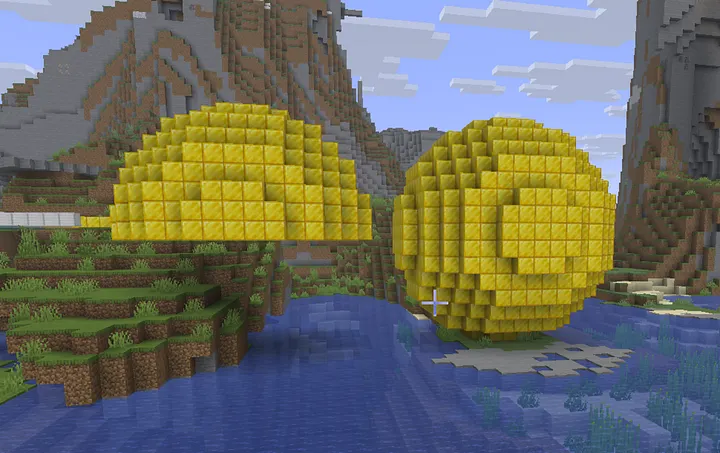
As part of my ongoing side project to build a Terraform-based library of Minecraft primitives, I’ve added a new shape to the collection: the dome. While it might seem like a simple variation on the sphere module, the dome unlocks something much larger — the ability to create structures rooted in Romanesque architecture, and even modern buildings inspired by it, like the Jefferson Memorial.
In architectural history, the dome has long symbolized grandeur, stability, and ambition — from the Pantheon in Rome to the Capitol in Washington. Bringing that shape into Minecraft, via Terraform and voxel geometry, allows me to begin shaping worlds with those same structural and symbolic patterns.
Why a Dome?
I wanted a dome so I could open up the creation of all sorts of Romanesque and neoclassical forms — structures that start with a round base and rise to a vaulted ceiling. The dome is more than a hemisphere; it’s an architectural gesture. It invites space underneath it, frames interiors with drama, and serves as a capstone for grand halls, temples, observatories, or even futuristic biodomes.
In a world built entirely of blocks, you can’t get smooth curves — but with a voxel approach, you can approximate them convincingly. This Terraform module does exactly that: computes which blocks belong to the upper half of a sphere and renders them as clean, horizontal scanlines.
Architectural Geometry in a Voxel Grid
The logic is nearly identical to the full sphere module. The difference? Instead of evaluating the full vertical range of a sphere, this module restricts itself to the top half:
y_indices_top = range(local.center_i, var.diameter)
This skips any blocks below the equator of the sphere, effectively “slicing off” the bottom and leaving a dome.
As before, it calculates the set of voxel cell centers that fall within the radius of a sphere using:
(x + 0.5 - r)^2 + (y + 0.5 - r)^2 + (z + 0.5 - r)^2 <= r^2
Each (y, z) row that satisfies this condition gets turned into a scanline — a horizontal run of blocks drawn in the X direction using the same vector module as the rest of the library.
Perhaps this is an opportunity for code reuse. I could refactor my sphere module to simply combine two domes. That way, as I optimize the performance of the dome module the sphere module would benefit.
Flexible Placement with Transforms
The dome can be placed precisely in the world by specifying a start_position, and further adjusted using a transform vector:
module "transformed_start_position" {
  source = "../position"
  start_position   = var.start_position
  translate_vector = var.transform
}
This makes it easy to drop domes at any height, offset them within a larger complex, or stack them on other primitives like cubes and cylinders.
Building with the Dome
With the dome module in place, I can now construct:
- Temple-like buildings with vaulted ceilings.
- Rotundas or circular pavilions.
- Modern neoclassical memorials, like the Jefferson Memorial, with domes rising above open colonnades.
- Interior domes inside massive structures — observatories, throne rooms, or cathedrals.
- Even spaceship hangars or sci-fi towers topped with domes.
Because the dome is built from reusable scanlines, you can scale it easily by changing the diameter — all the math takes care of itself.
Conclusion
This module is part of a larger library of Minecraft primitives defined entirely in Terraform. The idea is to make it easy to compose complex, reusable, parameterized structures — not just as one-offs, but as shareable building blocks. You can plug them together like LEGO sets made of code.
I started this library because I wanted more than just walls and floors — I wanted expressive shapes, architectural language, and structure with character. The dome adds a key piece to that vocabulary.
Perfect curvature may be out of reach in Minecraft, but with a voxel approach and Terraform’s power, we can get close — close enough to echo the domes of Rome, the Renaissance, or even Star Wars. And once you have a dome, the architectural possibilities expand dramatically.